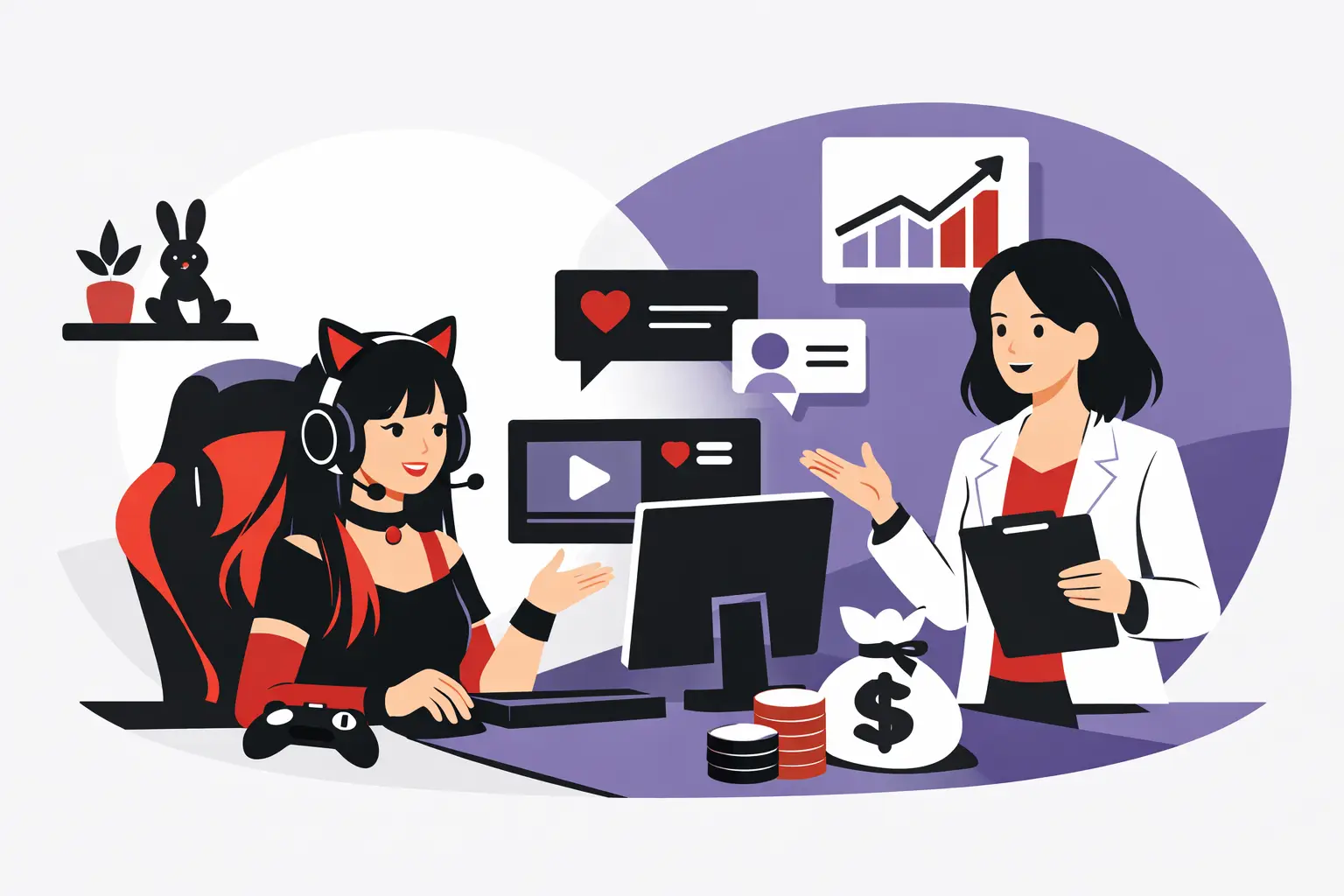
The difference between useful e-girl management and dead-weight representation shows up fast. If your manager only forwards emails, takes a cut, and calls it strategy, that is not support. Real e-girl management should make your brand sharper, your income more stable, and your business easier to run without sanding down the identity that made people follow you in the first place.
For creators working in e-girl, alt, cosplay, goth, or emo aesthetics, that distinction matters more than it does in mainstream talent spaces. Your audience is not responding to a generic influencer package. They are responding to taste, consistency, subcultural fluency, and a point of view. The right management understands that your look is not a costume for a campaign. It is the core of the business.
Why e-girl management needs a niche approach
A lot of agencies still treat alternative creators like a version of mainstream talent that just needs different styling. That is usually where the problems start. The pitches become vague, the positioning gets diluted, and the creator ends up pushed toward safer content, safer branding, and lower-value opportunities that miss the audience entirely.
Good e-girl management works from the opposite assumption. It treats niche identity as a commercial advantage. That means understanding the difference between trend-driven posting and long-term brand equity. It means recognizing that a creator with a strong alt identity often has a more engaged audience, clearer visual language, and stronger fan loyalty than a broadly marketable creator with no specific lane.
This is especially true on subscription platforms and creator-led channels, where income is tied directly to trust, consistency, and audience retention. In that environment, management is not just about getting brand deals. It is about building a business model around what already makes the creator valuable.
What e-girl management should actually include
At a premium level, management should cover more than inbox cleanup and occasional negotiation. It should create structure around growth.
The first piece is positioning. A creator may know their aesthetic instinctively, but management should be able to translate that into market language. Who is the audience? What makes the page distinct? Which parts of the visual identity are core, and which parts can evolve? If that work is missing, creators often end up posting constantly without building a stronger brand.
The second piece is monetization strategy. For many e-girl creators, especially those active on OnlyFans and adjacent platforms, the biggest gains do not come from doing more. They come from tightening the offer. Pricing, content cadence, upsell logic, promotion strategy, custom content boundaries, and audience segmentation all affect revenue. A manager should be able to help shape that system with the creator, not impose a formula that ignores the audience they have built.
The third piece is commercial representation. Negotiating rates matters, but so does filtering. Not every collaboration is good for the brand. Not every request deserves a yes. Strong management protects time, image, and leverage. That protection is worth more than a long list of mediocre deals.
Then there is operations. Scheduling, campaign handling, follow-up, deliverables, and partner communication are not glamorous, but they determine whether a creator can scale without burning out. The more a career grows, the more operational mistakes become expensive.
The real job: growth without dilution
This is where many creators get let down. They sign with representation expecting expansion and end up feeling less like themselves. Their page starts to look flatter. Their captions lose edge. Their offers become generic. Revenue may even rise briefly, but the brand gets weaker underneath it.
That is not sustainable growth. It is short-term optimization at the expense of identity.
The best e-girl management protects the tension that makes a creator commercially interesting. The look has to stay specific. The voice has to stay recognizable. The audience has to feel that access is still real, even as the business becomes more professional. Management should bring structure behind the scenes so the front-facing brand can stay sharp, not over-managed.
There is always a balance here. Some creators need more planning because they are leaving money on the table. Others need less interference because over-planning kills spontaneity. A strong manager knows the difference. One creator may benefit from a tighter launch calendar and clearer upsells. Another may need help with selective partnerships and stronger boundaries, not more content volume.
Red flags creators should take seriously
If an agency cannot explain how it manages alternative talent differently from mainstream creators, that is a warning sign. So is any promise that sounds too easy. Fast growth claims usually skip the part where creator businesses become fragile when they scale without systems.
Another red flag is pressure to become more broadly appealing. That usually means more diluted. If your aesthetic is the reason your audience cares, sanding it down to fit a wider market often lowers your value instead of raising it. Broad appeal is not automatically premium. In many cases, specificity sells better.
Opaque payment structures are another issue. Creators should know what the agency takes, what it covers, what support is included, and where responsibilities start and end. Transparent management is not a nice extra. It is the baseline.
It is also worth paying attention to how a manager talks about control. Good representation reduces admin pressure and improves decision-making. It should not make the creator feel replaceable inside their own business. If the relationship depends on confusion, gatekeeping, or vague promises, it is not creator-first.
What creators gain from strong e-girl management
The obvious benefit is revenue growth, but that is only one part of it. Better management gives creators clearer positioning, stronger negotiation power, and more consistency across platforms. It creates room to think beyond next week’s content and focus on what the brand should look like six months from now.
That shift matters because online attention is volatile. Algorithms move. Audience behavior changes. Aesthetics cycle in and out of trend language. Creators who last are rarely the ones chasing every shift. They are the ones with enough structure to adapt without losing coherence.
Strong management also helps creators avoid a common trap in digital-first careers: confusing activity with progress. Posting more, replying more, and accepting more opportunities can feel productive while quietly making the business messier. Good representation is partly about subtraction. Better offers. Better pacing. Better decisions.
For creators in alt spaces, that support carries an added layer of value. Too many traditional agencies still misunderstand niche aesthetics unless they can package them as novelty. A management team with actual cultural fluency does not need your identity translated into something more comfortable. They know how to represent it as premium from the start.
A creator-first standard
A creator-first model sounds obvious, but in practice it is still rare. It means management is built around the creator’s long-term leverage, not around extracting as much short-term value as possible. It means setting up cleaner deals, clearer systems, and a business structure that respects the fact that the creator is the asset.
That is especially relevant for e-girl creators whose careers often grow out of highly personal audience relationships. Trust is part of the product. So is consistency. So is perceived authenticity. Management has to support those things, not interfere with them.
The agencies worth working with understand that professionalism and subcultural authenticity are not opposites. Premium does not mean sanitized. Fair representation does not mean passive service. It means active, informed support with clear incentives and transparent communication. That is the standard creators should expect.
Beyond Caption was built around that exact gap in the market: premium, transparent support for alternative creators who want real business infrastructure without being pushed into a generic mold.
If you are considering management, the right question is not whether someone can help you get bigger. Plenty of people can help you get busier. The better question is whether they can help you build a sharper, more durable brand while keeping control where it belongs - with the creator.